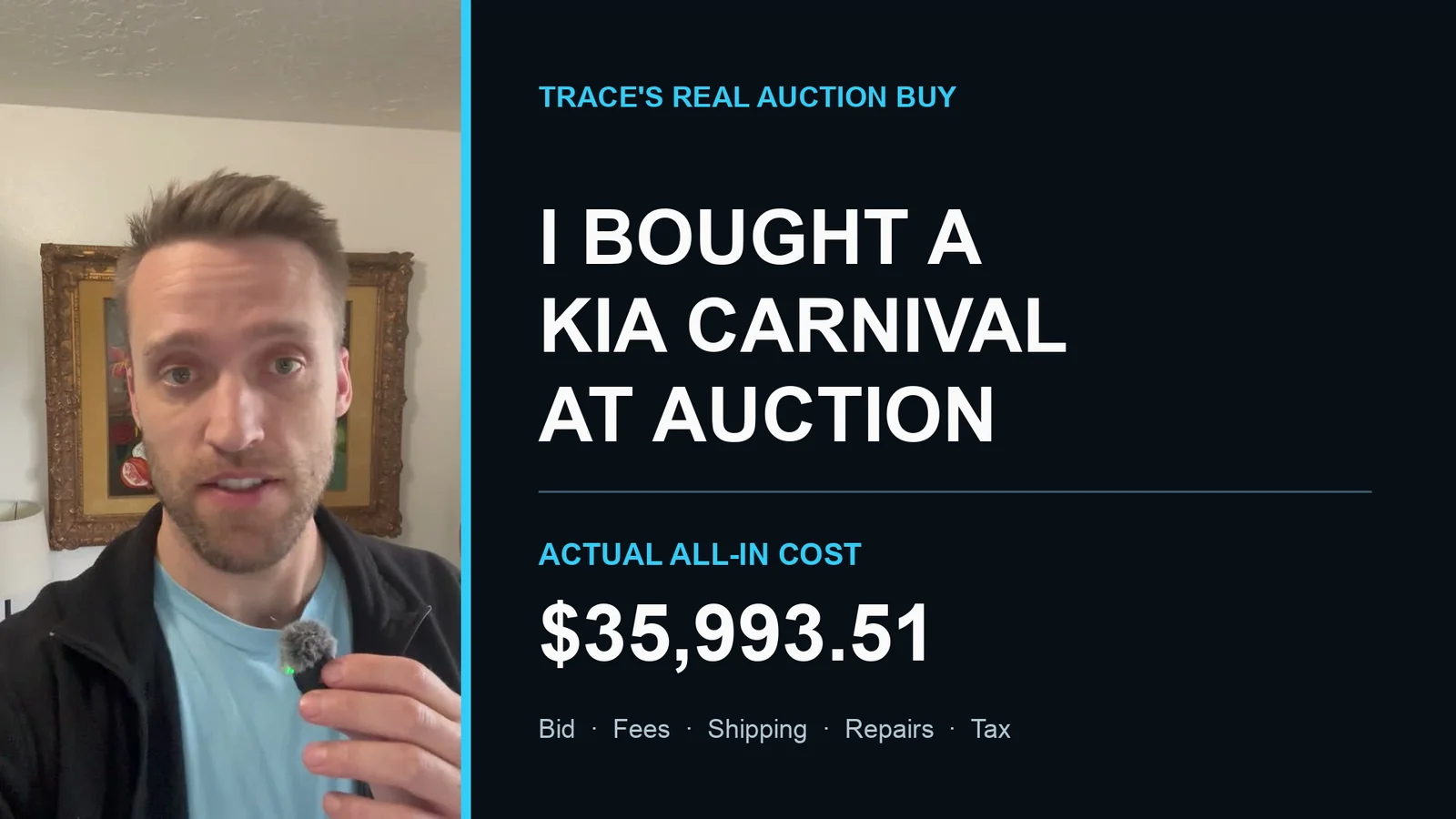
This year we had our second child, and it was time for a minivan. I liked the Kia Carnival, but the prices I was seeing pushed me to look at another option: an insurance salvage auction.
We ended up with a 2026 Carnival that had damage around one wheel. I bought it through an auction broker, had it transported to Utah, and paid a body shop and mechanic to repair it. My recorded total, including the bid, fees, shipping, repairs, tax, and registration, was $35,993.51.
Here’s the entire process. I also shared my cost spreadsheet so you can put your own numbers beside mine.
This is one purchase, not a promise that any particular auction car will be a deal. The damage, title, eligibility, fees, and repair bill can change everything.
First, I learned where and how to bid
I started watching IAA and Copart. You can browse their inventory and watch auctions, but being able to bid on a specific car is another question. Some lots are open to individual buyers; others require the right license or a broker. The rules depend on the lot and location, so I checked eligibility before getting attached to a car.
I paid for memberships on both platforms while I was learning. For the Carnival purchase, I used a broker. The broker handled the auction access and charged separate fees. I compared brokers because a flat charge and a percentage of a car’s price can produce very different totals. I also learned to ask about document and payment fees before bidding. My spreadsheet includes those costs, including the memberships I bought along the way.
The other thing to understand is the bidding deposit. I had to have money available before I could make a serious bid, and using a credit card could add a fee. Deposit and refund rules vary by account and platform. For example, Copart’s current Basic Member policy calls for a 10% security deposit when bidding above $2,000. Read the terms for the route you’re actually using, especially what happens if you win and fail to pay.
I watched auctions before trying to win one
I saved Carnivals on both sites and watched the live bidding. That mattered more than I expected. The action got fast near the end, and I could feel how easy it would be to bid just because the clock was running out.
After buying the Carnival, I found Stat.vin. It lets me look up VINs, past auction photos, damage descriptions, and sale results. I wish I’d known about it while I was shopping for our car; it’s useful for judging what similar cars have attracted in bids.
If you’re new to this, watch a few auctions for cars you aren’t ready to buy. Get used to the pace. I would budget real time for the search, too. For a first purchase, I think 50 hours or more of research, calls, bidding, and logistics is a realistic expectation. A dealership charges for convenience; this process asks you to do much of that work yourself.
I tried to price the damage before the auction
Auction photos can hide expensive problems. I asked people with repair experience to look at the listings I was considering. I even used AI to help sort possible damage risks, but it was a starting point, not a diagnosis. For a serious bid, I wanted a body shop or mechanic’s opinion and at least a rough repair range.
I was specifically cautious about sliding-door and electrical damage on a minivan. That was my own risk threshold. The Carnival I chose appeared to have damage concentrated around a wheel, with a possibility of nearby door damage. The repair people I consulted thought suspension parts were more likely to be involved than an axle. I couldn’t know for sure from pictures, but I felt I could make a more informed bid on that damage than on a car with problems I couldn’t see.
It wasn’t just a cosmetic job. The final bill included both body work and suspension repairs.
I set a ceiling, then bid
My first target was roughly $22,000 to $25,000. In the hour before the auction, I reconsidered it. Carnivals with the features I wanted weren’t coming through often, and I was willing to go higher for this one. I decided on my maximum before the final bidding started.
Another bidder stayed in, and I bid in the last seconds. The winning bid recorded on my cost sheet was $26,750. I was glad to get the car, but the live auction also showed me how emotion can push a price up. Next time I’d set my ceiling earlier and be more decisive instead of trading bids in the final seconds.
The bid was only the starting number. I needed funds ready for the auction and broker payment terms, and I had to account for the fees and the work still ahead.
Transport was my first surprise after winning
I initially tried to arrange a lower-cost shipment through my broker. The job sat without a carrier taking it. In my case, the auction pickup window was running out, and I didn’t want a storage charge on top of everything else.
I switched to IAA’s transportation service. It took about another week to get the Carnival moving, but that was the safer choice for my situation. Transport to Utah cost $1,382. The route, vehicle size, timing, and pickup rules all affected my options. If I did this again, I’d price and plan transport before the auction rather than treating it as an afterthought.
Then came two different repairs
I sent the Carnival straight to a body shop. The shop reformed and repainted the damaged metal rather than replacing entire panels. That cost $1,400.
Then a mechanic handled the wheel-area mechanical work, including suspension components. The cost sheet records $1,000 for suspension repairs. I wanted separate opinions on appearance and mechanical safety; one quote would not have covered both.
In Utah, the title and registration process also needed attention. The Utah DMV explains how salvage and rebuilt titles work and lists a safety inspection for a rebuilt salvage vehicle seeking a rebuilt title. My spreadsheet includes the tax, safety and emissions checks, and DMV registration I paid. Check your own state’s rules before assuming you can drive an auction car home.
What our Carnival actually cost
Here’s what I paid by category:
| Cost | Amount |
|---|---|
| Winning auction bid | $26,750.00 |
| Auction fees, memberships, broker, and payment costs | $2,972.84 |
| Transport | $1,382.00 |
| Body work | $1,400.00 |
| Suspension repairs | $1,000.00 |
| Tax, inspections, and DMV registration | $2,488.67 |
| Total paid | $35,993.51 |
The bid plus auction-related costs came to $29,722.84 before transport or repairs. The full itemized cost spreadsheet shows each fee, including charges a different buyer might avoid or replace. Make a copy and change the numbers for the car and state you’re considering.
Would I do it again?
Yes, with my eyes open. We got the minivan we wanted, and we know what we paid. But we also took a real risk that the damage could be worse than the listing suggested. The time I spent researching, the repair advice I got before bidding, and the ceiling I set made that risk more manageable for me.
If you’re considering an auction car, my biggest lessons are simple: watch auctions before bidding, get real repair opinions, calculate the full cost, and arrange a transport plan early. A low winning bid means very little until you’ve priced everything that comes after it.
You can start with my Kia Carnival cost spreadsheet.